Freediving Equalization Techniques - A Complete Guide for Beginners
Learn freediving equalization step by step - Valsalva, Frenzel and mouthfill explained, plus land drills, common problems and how to equalize safely.
 BuoyBuddy
Learn how to hold your breath longer with safe static apnea training. Relaxation, breathe-up, CO2 and O2 tables explained, plus common mistakes to avoid.
In short
You hold your breath longer by relaxing more, tolerating rising CO2 and building comfort with contractions - not by hyperventilating or forcing it. Dry CO2 and O2 tables done lying down on land, with someone present, are the safest way to train at home, and in-water breath-holds should only ever happen with a trained buddy.
If you want to know how to hold your breath longer, the answer is not more willpower. It is less tension. Your breath-hold is limited mostly by how relaxed you are, how efficiently you use oxygen and how well you tolerate the rising urge to breathe. All three can be trained, and the improvements often come faster than people expect.
This guide explains the physiology in simple terms, shows you how to prepare for a breath-hold, and walks through static apnea training with CO2 and O2 tables. Everything here assumes dry training on land. Any breath-hold in water must be done with a trained buddy, ideally after learning on a course with a qualified instructor.
The first thing to understand is that the urge to breathe is driven mainly by carbon dioxide, not by a lack of oxygen. As you hold your breath, CO2 builds up in your blood. Sensors in your body detect this and create the uncomfortable urge to breathe, followed later by contractions of the diaphragm.
Oxygen, meanwhile, falls more slowly and without much sensation. That is the core safety problem in freediving: you cannot feel your oxygen running low. When it drops too far, you lose consciousness - a blackout - often with little or no warning. Our guide to blackout and samba explains this in detail.
So breath-hold training targets two separate things:
Before tables, before techniques, comes relaxation. A tense body burns oxygen fast and a racing mind makes the urge to breathe feel urgent. Practice these on their own until they become automatic:
The breathe-up is the calm breathing you do before a breath-hold. Its job is to relax you, not to load extra oxygen. A typical beginner breathe-up lasts around two minutes of slow, relaxed belly breathing, with the exhale noticeably longer than the inhale.
Finish with one full but comfortable final breath - fill from the belly up through the chest without straining - and begin the hold. Our full guide to the freediving breathe-up technique covers ratios, the final breath and recovery breathing.
A CO2 table trains you to tolerate rising carbon dioxide. The breath-hold time stays the same each round, while the rest between holds gets shorter. Because you start each hold with a little more CO2 left over from the last one, the urge to breathe and contractions arrive earlier and you practice staying calm through them.
The hold is usually set at roughly half of your current comfortable maximum dry static. Here is an example table for someone whose comfortable max is about 2 minutes:
| Round | Rest (breathing) | Hold |
|---|---|---|
| 1 | 2:00 | 1:00 |
| 2 | 1:45 | 1:00 |
| 3 | 1:30 | 1:00 |
| 4 | 1:15 | 1:00 |
| 5 | 1:00 | 1:00 |
| 6 | 0:45 | 1:00 |
| 7 | 0:30 | 1:00 |
| 8 | 0:30 | 1:00 |
Tips for CO2 tables:
An O2 table trains your tolerance to lower oxygen levels. The rest between holds stays the same, while the hold time gets longer each round. The final holds approach, but stay comfortably below, your maximum.
Here is an example for the same diver with a comfortable max of about 2 minutes:
| Round | Rest (breathing) | Hold |
|---|---|---|
| 1 | 2:00 | 1:00 |
| 2 | 2:00 | 1:10 |
| 3 | 2:00 | 1:20 |
| 4 | 2:00 | 1:30 |
| 5 | 2:00 | 1:35 |
| 6 | 2:00 | 1:40 |
| 7 | 2:00 | 1:45 |
| 8 | 2:00 | 1:45 |
O2 tables are more demanding than CO2 tables and carry more risk, because the later holds bring you closer to your limits. Keep the top holds clearly below your max - many coaches suggest around 80 percent - and never turn an O2 table into a max attempt.
Contractions are involuntary movements of the diaphragm that start when CO2 builds up. They might feel like hiccups, a pulsing in the belly or a strong urge to swallow. For many beginners they are the moment the hold feels like it is ending.
They are not a sign that you are out of oxygen. They are a CO2 signal, and with training they become just another sensation. To manage them:
Progress is usually fastest at the start. Many people gain significant time in their first few weeks simply by learning to relax and by becoming familiar with the urge to breathe. After that, improvement slows and becomes steadier.
Realistic expectations help you train safely:
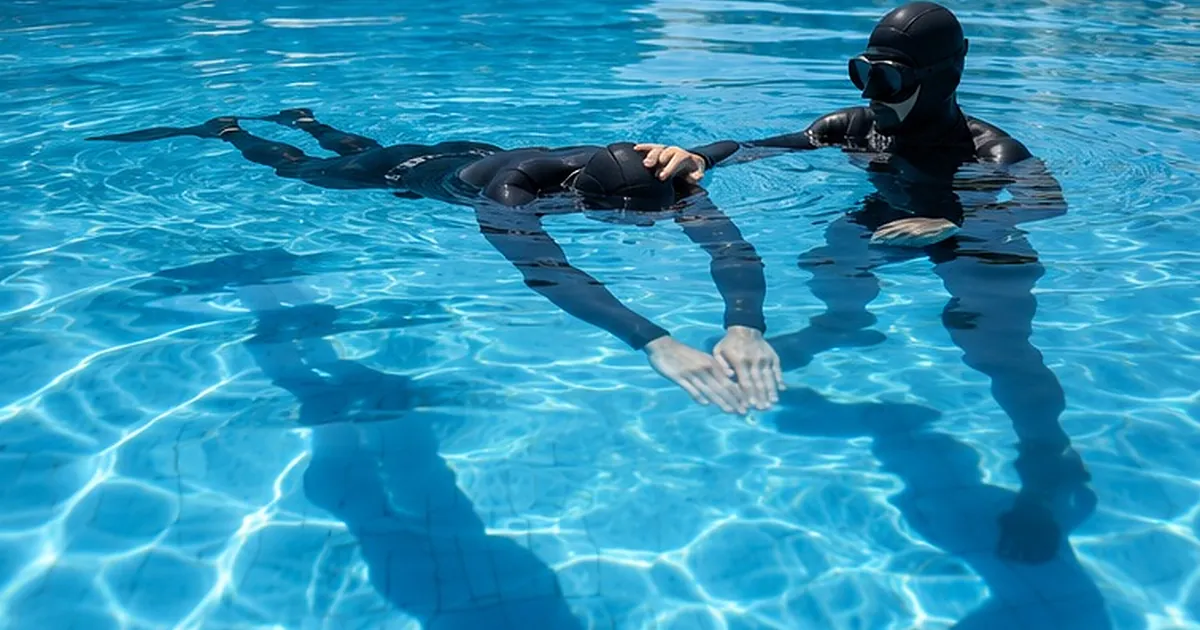
Dry training builds the foundation, but static in the pool is where you really learn to relax in water. Do it only with a trained buddy who stays beside you, watches you closely and uses a simple touch-and-signal protocol to check you are conscious. Our guide on freediving safety rules and the buddy system explains how that protocol works.
If you do not have a training partner yet, a local club is a great place to start, and BuoyBuddy - our freediving buddy-finder app coming soon to iOS and Android - is being built to help you find nearby divers to train with. Whatever you do, keep the golden rule: never hold your breath in water alone.
Untrained adults often manage somewhere around 30 seconds to a minute before the urge to breathe becomes strong. After a few days of relaxation training on a course, many beginners are surprised to reach two minutes or more in a supervised static. Progress varies a lot between people, so compare yourself only to your own past results.
CO2 tables are relatively low risk when done dry, lying down on a bed or floor, with someone nearby and never in or near water. Stop the session if you feel dizzy, tingly or unusually tired. Never do breath-hold training while driving, standing, in the bath or in a pool alone.
It can delay the urge to breathe, which is exactly why it is dangerous. Hyperventilation lowers CO2 without meaningfully raising stored oxygen, so your body loses its early warning signal and you can black out without feeling it coming. Freedivers breathe calmly and normally before a hold instead.
A common approach is a few dry sessions per week, with no more than one table per day and rest days in between. Many coaches suggest not doing CO2 and O2 tables on the same day. Listen to your body and back off if sessions start to feel harder rather than easier.
Contractions are involuntary movements of the diaphragm triggered by rising CO2. They feel like hiccups or a pumping sensation in the chest and belly. They are a normal signal rather than a sign of low oxygen, and learning to stay relaxed through them is a core freediving skill.
Coming soon to iOS & Android
See freedivers near you, join pool and depth sessions, agree the dive plan and log every dive.
Learn freediving equalization step by step - Valsalva, Frenzel and mouthfill explained, plus land drills, common problems and how to equalize safely.
Use this freediving weight calculator method to estimate your starting weight by wetsuit and water type, then fine-tune it in the water for safe dives.
Freediving disciplines explained in plain English. Learn what CWT, CWTB, CNF, FIM, STA, DYN, DYNB and DNF mean, what each trains and where to start.