Freediving Breathe-Up Technique - How to Breathe Before a Dive
Master the freediving breathe up. Learn how to breathe before freediving, take a safe final breath, use recovery breathing and avoid hyperventilation.
 BuoyBuddy
Learn freediving equalization step by step - Valsalva, Frenzel and mouthfill explained, plus land drills, common problems and how to equalize safely.
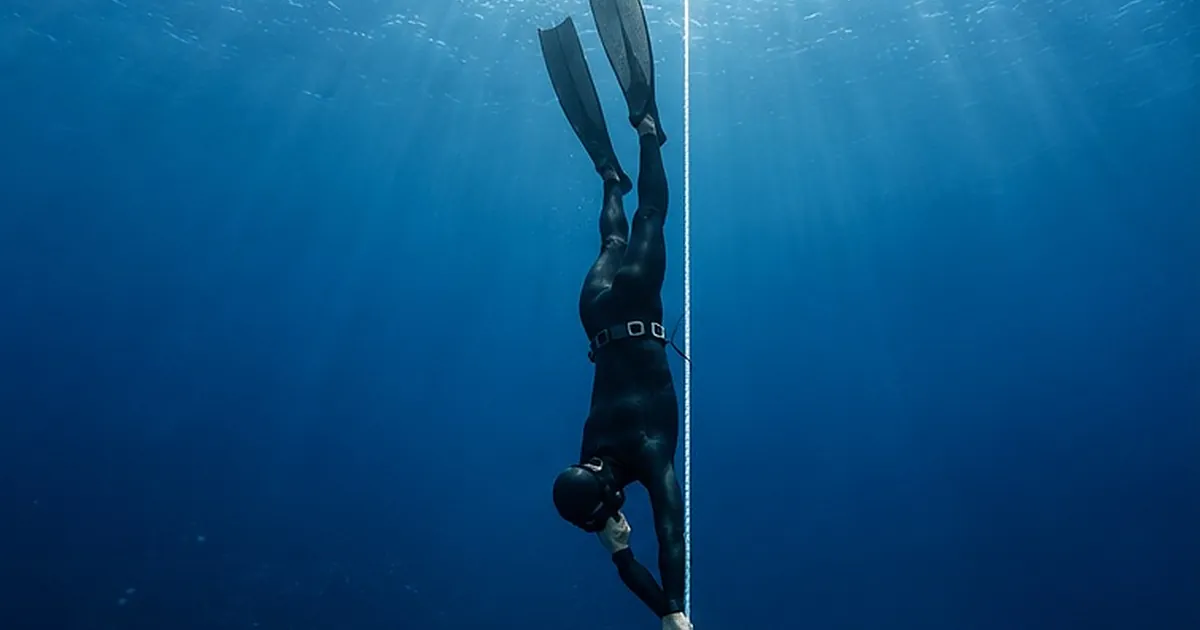
In short
Freediving equalization means adding air to your middle ears, sinuses and mask so their pressure matches the water as you descend. Most beginners start with Valsalva but should learn the Frenzel technique, which uses the tongue instead of the lungs and works far better head-down, and mouthfill comes later for deep dives. Equalize early and often, never force it, and turn the dive if your ears will not clear.
Equalization is the skill that limits more beginner freedivers than breath-hold ever does. You can have a three-minute static and still be stuck at 12 meters if your ears will not clear. This guide explains how freediving equalization works, walks through the Valsalva, Frenzel and mouthfill techniques, and gives you land drills and fixes for the most common problems.
The short version: learn Frenzel as early as you can, equalize before you feel pressure, slow down, and never force it.
Water pressure increases by about one atmosphere for every 10 meters of seawater. At the surface you are at 1 bar; at 10 meters you are at 2 bar, so any air space in your body is squeezed to half its surface volume. The biggest proportional change happens in the first 10 meters, which is why beginners feel their ears so early.
The air spaces that matter are:
Equalizing simply means pushing a small amount of air into these spaces so their pressure matches the water around you. The question is where that air comes from and what pushes it, and that is the real difference between the techniques.
Valsalva is what most people do instinctively: pinch your nose, close your mouth and gently blow as if blowing your nose.
How it works: your chest and diaphragm muscles pressurize the air in your lungs, and that pressure travels up through an open glottis into the throat and Eustachian tubes.
Why it has limits for freediving:
Valsalva can get you through your first pool sessions and shallow dives. Most freedivers find it becomes unreliable somewhere in the first 10 to 20 meters, and it rarely works for head-down descents beyond that. Treat it as a stepping stone, not a technique to build on.
The Frenzel technique is the standard method in modern freediving courses. Instead of using your lungs as the pump, you use your tongue and throat as a small piston, with your glottis closed so the lungs are taken out of the equation.
The movement is small and fast. If your cheeks puff out or you feel your chest tighten, you are probably slipping back into Valsalva.
Practice for five to ten minutes a day. Many divers take a few weeks before it feels automatic.
As you go deeper, your lungs compress toward their residual volume, and there is eventually not enough air left to draw up into your mouth for a normal Frenzel. For many divers this happens somewhere between 20 and 40 meters, depending on lung size, flexibility and technique. Mouthfill solves this.
The idea, described at a high level:
Mouthfill is a genuinely advanced skill. It needs good thoracic flexibility, relaxation at depth and solid Frenzel first. It is taught on intermediate and advanced courses, and you should learn it with an instructor on a line rather than from a video.
Beyond mouthfill, some divers can open their Eustachian tubes with muscle control alone, often called hands-free or voluntary equalization. It is useful, but not everyone can learn it, and it is not required to become a confident diver.
Good equalization is a habit, not a single move. Use the same routine every time:
Head position matters. Keep your chin neutral and your neck relaxed; tucking your chin hard or craning to look down tenses the throat and can close the Eustachian tubes.
| Problem | Likely cause | What to try |
|---|---|---|
| Ears stop clearing around 10 to 15 meters | Still using Valsalva | Drill Frenzel on land and in feet-first dives |
| One ear clears, the other does not | Tension, head tilt, mild congestion | Tilt your head slightly toward the stubborn ear, slow down, try again gently |
| Ears clear on land but not underwater | Descending too fast, head-down tension | Slow down, go feet-first, start equalizing earlier |
| Frenzel fails deeper down | Running out of air in the mouth | Recharge the mouth earlier, work toward mouthfill with an instructor |
| Pain or fullness after diving | Mild barotrauma | Stop diving and see a doctor if it persists |
Stop diving if you feel sharp pain, hear crackling that does not settle, feel dizzy or nauseous after equalizing, notice muffled hearing, or see blood in your mask. Vertigo or ringing after a dive can indicate inner-ear injury, which needs prompt medical attention.
Do not dive with a cold, allergy flare or sinus infection. Congestion makes equalizing difficult, and if air gets trapped on the way down it can cause a reverse block on the way up. Hydration, avoiding dairy-heavy meals right before diving and nasal rinses help some divers, but they are no substitute for being healthy.
Depth progress should follow equalization progress, not the other way around. A few principles:
Finding a regular training partner makes all of this easier, since equalization improves with frequent, relaxed sessions. BuoyBuddy, the freediving buddy-finder app coming soon to iOS and Android, is built to help you find buddies nearby and plan line sessions together.
Head-down position, tension in the neck and jaw, and descending too fast all make equalizing harder in the water than on a couch. Try slower feet-first descents on a line, keep your chin neutral, and start equalizing at the surface before you feel any pressure.
Early in the dive pressure changes fastest, so most divers equalize roughly every meter or every kick cycle in the first 10 meters. Deeper down the pressure change per meter is smaller, so you can space equalizations out, but never wait until you feel pain.
Valsalva is not dangerous when done gently, but it relies on pressure from your lungs and chest, which becomes unreliable as the lungs compress and when you are upside down. It is also easy to blow too hard. Most freedivers find it stops working somewhere in the first 10 to 20 meters, which is why Frenzel is taught as the standard technique.
Mouthfill becomes useful when your lungs are compressed so much that you can no longer draw air up for a normal Frenzel, which for many divers happens somewhere between 20 and 40 meters. It is an advanced skill best learned from an instructor on an intermediate or advanced course.
It is generally not recommended. Decongestants can wear off during a dive and cause a reverse block on ascent, and they mask the fact that you should not be diving with congestion. If you have persistent trouble equalizing, see a doctor or ENT, ideally one familiar with diving.
Coming soon to iOS & Android
See freedivers near you, join pool and depth sessions, agree the dive plan and log every dive.
Master the freediving breathe up. Learn how to breathe before freediving, take a safe final breath, use recovery breathing and avoid hyperventilation.
Use this freediving weight calculator method to estimate your starting weight by wetsuit and water type, then fine-tune it in the water for safe dives.
Freediving disciplines explained in plain English. Learn what CWT, CWTB, CNF, FIM, STA, DYN, DYNB and DNF mean, what each trains and where to start.